Saturday, November 25, 2006

Caption Competition


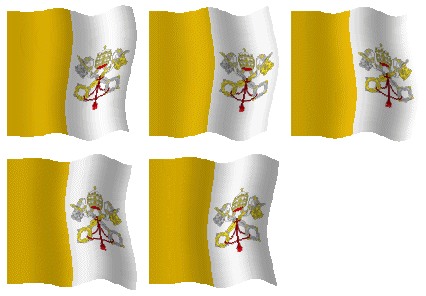
There are a few suggestions for a suitable caption for this image doing the rounds.


Mine is:

'Rowan, I thought we were both against same-sex civil unions!'


Any more suggestions?

Tuesday, November 21, 2006

Cardinal Numbers

As any number of religious blogs will tell you, today William Cardinal Baum ceases to be a voting member of the College of Cardinals. What makes this event notable is that Baum was the last remaining voting member of the College to be appointed by Pope Paul VI (1963-1978). The only other Pauline appointee who remains under the age of 80 is the present Pontiff, Benedict XVI. As of today, of the 114 Cardinal Electors, 102 were appointed by Pope John Paul II (1978-2005) and 12 were appointed by Pope Benedict XVI (2005-).

Baum was elevated to the College of Cardinals in May 1976. That means he was a voting member of the College for about 30.5 years. That got me thinking about whether this makes him one of the longest serving twentieth century cardinals (in terms of being able to vote in a papal election).

Of course things were complicated a little by Pope Paul's November 1970 Motu Proprio, Ingravescentum aetatem. This stated that as of 1 January 1971 Cardinals who had reached the age of 80 would no longer be able to participate in conclaves.

So then, is Baum the longest-eligible papal voter of the last 100+ years? Actually, no; there are a number of other cardinals who were eligible to vote for longer than Baum's 30.5 years. These include Cardinal Landázuri Ricketts of Lima (31 years), Cardinal Léger of Montréal (31 years), Cardinal Rugambwa of Dar-es-Salaam (32 years), Cardinal Siri of Genoa (33 years), Cardinal Tisserant, a curial official (33 years) and Cardinal Liénart of Lille (40.5 years).

However the winner by a nose is Cardinal Manuel Gonçalves Cerejeira, Patriarch of Lisbon. Elevated to the College of Cardinals at the age of 41 by Pope Pius XI (1922-1939) in 1929 (incidentally during the same Consistory that saw the elevation of a certain Eugenio Pacelli), Cerejeira was only relieved of his right to vote in a papal election by the implementation of Ingravescentum aetatem in January 1971, just over 41 years later. Cardinal Cerejeira died in August 1977 at the age of 88.

Saturday, November 18, 2006

San Pietro in Vaticano

Today, 18 November, is the feast day of the dedication of two of Rome's great basilicas, San Pietro in Vaticano and San Paolo fuori le Mura.

The current St Peter's is, of course, the second great church on that site. The original Constantinian basilica was dedicated by Pope Sylvester I on 18 November 326. This building survived until the papacy of Julius II who laid the foundation stone of a new basilica in 1506. Julius (he of the Sistine Chapel ceiling) envisaged a great church at the centre of which would stand his tomb. In the event the parts of his tomb that were completed (including Michelangelo's Moses) were located in the chuch of San Pietro in Vincoli (Julius' titular when he was plain old Cardinal Giuliano della Rovere) although Julius himself is buried, somewhat ironically, in an almost unmarked grave in St Peter's (the location of the tomb is currently marked by a simple plaque in the floor of St Peter's in front of the monument to Pope Clement X).

The building of the great basilica took well over a century, being dedicated - again on 18 November - in 1626 by Pope Urban VIII. It was under Urban's patronage that Gian Lorenzo Bernini completed some of his greatest masterpieces including the baldacchino which towers over the papal altar in St Peter's. Much of the bronze that makes up this creation is rumoured to have come from the Pantheon. This resulted in the emergence of the famous quote "Quod non fecerunt Barbari, fecerunt Barberini" ("What the barbarians didn't do, the barberini (Urban's family name)did").

The current St Paul's Basilica is of relatively recent origin despite its ancient basilical appearance. The original church was burnt down in 1823. With worldwide donations it was rebuilt on the same foundations and dedicated by Pope Pius IX in 1854.

Monday, November 13, 2006

Yippee!

Hooray, I've finally had a comment - more than one indeed. I thought that I was wasting my time in writing this blog. Of course I'm under no illusions that anyone should read it, but it's nice to see someone is - at least occasionally.

Who's the reader? None other than the great Joee Blogs

More soon!

Monday, November 06, 2006

Vote Facts!

Fr Guy Selvester makes an excellent point in his latest posting on his erudite blog, Shouts in the Piazza.

In the context of the US mid-term elections, Fr Selvester is ruminating about the importance of each and every vote; he suggests - correctly - that “decisions are made by people who show up.”

To support the argument that he is making, Fr Selvester states that “President Hayes was elected by one vote” and adds that “In a most dramatic example, Hitler took democratic control of the Nazi Party in 1923...by just one vote.”

While supporting the veracity of the points he makes, I’m not too sure that the two examples Fr Selvester uses are the most appropriate ones that he could have chosen.

Rutherford B Hayes did indeed win the 1876 Presidential Election by one vote; however it was one Electoral College vote and not one popularly cast ballot, which is a very different thing. Indeed to further undermine Fr Selvester’s argument I might add that Hayes’ Democratic opponent, Samuel J Tilden, received about 250,000 more popularly cast votes than Hayes. As a result Hayes became known as “Rutherfraud”!

So, a quarter of a million more people showed up for Tilden than for Hayes, but their votes didn’t count.

On 26 July 1921 Hitler was appointed Chairman of the National Socialist German Workers’ Party. This appointment was not the result of a democratic vote, or indeed any vote. Instead it was a panicked reaction of the Party’s existing leadership to Hitler’s petulant resignation from the Party over its refusal to listen to his opposition to a planned merger with the DSP. Fearing that the Party would collapse without the influence of its most gifted member, the leadership capitulated and gave in to his demand to be appointed Chairman with dictatorial powers.

I’m not too sure if there were very many votes within the Nazi Party that could be described, even loosely, as “democratic”.